

The Word-Guessing Trap: Why Context Clues Fail Growing Readers
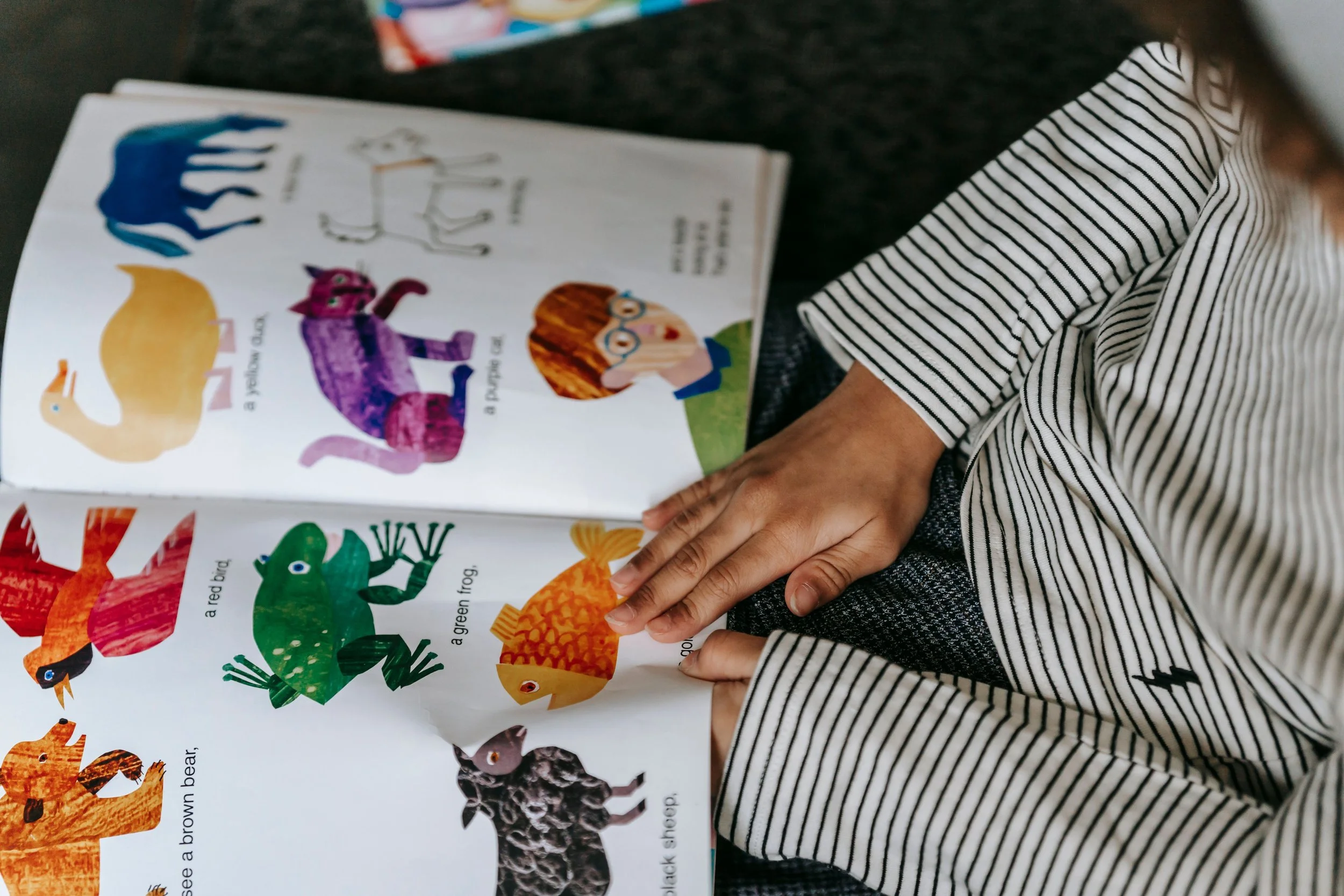
A child reading the book Brown Bear, Brown Bear, What do You See?
When young children learn to read, parents often celebrate their cleverness. A child comes to a tricky word, looks at the picture on the page, glances at the first letter, and triumphantly shouts out the correct word. It feels like magic.
In many early childhood settings, strategies like looking at the picture, guessing based on the first letter, or asking "What word would make sense here?" are taught as valid reading tools.
However, relying on context clues and visual prompts creates a hidden ceiling on a child’s literacy development. While word-guessing might look like reading in early books, it quickly becomes a major barrier to long-term success.
The Illusion of Success in Early Books
In Kindergarten and early 1st grade, books are designed with predictable patterns and heavy visual support. If a page says "The horse is in the barn" next to an illustration of a horse standing in a red barn, a child doesn't actually need to decode the word b-a-r-n. They just need to look at the picture.
This creates the illusion of reading fluency. The child gets the word right, the parent or teacher praises them, and the habit of word-guessing is reinforced.
The problem? Guessing is not reading.
Reading is the process of translating written letters (graphemes) into their corresponding sounds (phonemes) to recognize words, a process cognitive scientists call decoding. Guessing bypasses this step entirely.
What Happens When the Pictures Disappear?
Around 3rd and 4th grade, a major shift happens in school: students transition from learning to read to reading to learn.
At this stage, three critical changes occur in the text:
Illustrations vanish: There are no picture clues to rely on.
Vocabulary becomes complex: Multi-syllabic, abstract words appear frequently.
Sentence structures diversify: You can no longer rely on simple sentence patterns to predict the next word.
When a child who relies on guessing hits this "3rd-grade wall," their strategy completely falls apart. Trying to guess complex, multi-syllabic words without strong decoding skills leads directly to deep frustration and reading fatigue. Reading transforms from an enjoyable activity into an exhausting guessing game where every page is a struggle.
How the Brain Actually Learns to Read
Cognitive neuroscience shows that skilled readers do not sample words or skip around using context to guess what comes next. In fact, proficient readers process every single letter in a word in a fraction of a second.
This happens through a cognitive process called orthographic mapping.
Phonemic Awareness: The brain breaks spoken words down into individual sounds.
Letter-Sound Mapping: The brain connects those sounds to visual letter patterns.
Instant Retrieval: Once a word is decoded accurately a few times, the brain "maps" it into permanent memory for instant, effortless recall.
When children guess words instead of sounding them out, orthographic mapping cannot take place. The brain never anchors the visual spelling to its pronunciation and meaning, forcing the child to re-guess the same word over and over again.
3 Ways to Break the Guessing Habit at Home
If you notice your child using pictures, looking up at the ceiling to think of a word, or guessing based on just the first letter, here is how you can gently intercept the habit and build true decoding strength:
1. Cover the Picture
When introducing a new book or working through a sentence with a tricky word, temporarily cover the illustration with your hand or a sticky note. Ask your child to read the text first, then uncover the picture as a reward to confirm the scene. This keeps their focus anchored where it belongs: on the print.
2. Prompt with Look at the Letters
If your child comes to the word stream and guesses river, avoid asking Does that make sense? While river makes sense in context, it ignores the print completely.
Instead, direct their focus back to the letters:
"Look at the first two letters. What sounds do s and t make?"
"Keep your eyes on the word and slide through every sound."
3. Use Decodable Books for Practice
Ensure your child spends time practicing with decodable texts—books specifically written using sound patterns they have explicitly learned. Decodable books remove the temptation to guess because the text relies entirely on phonics skills the child already possesses.
Building Strong, Confident Readers
Phrases like use the picture or look at the first letter were popularized with good intentions, but the science of reading clearly shows that true fluency comes from explicit, systematic phonics practice.
By replacing guessing habits with solid decoding skills, we give children the tools they need to tackle any text with confidence!
Library of books